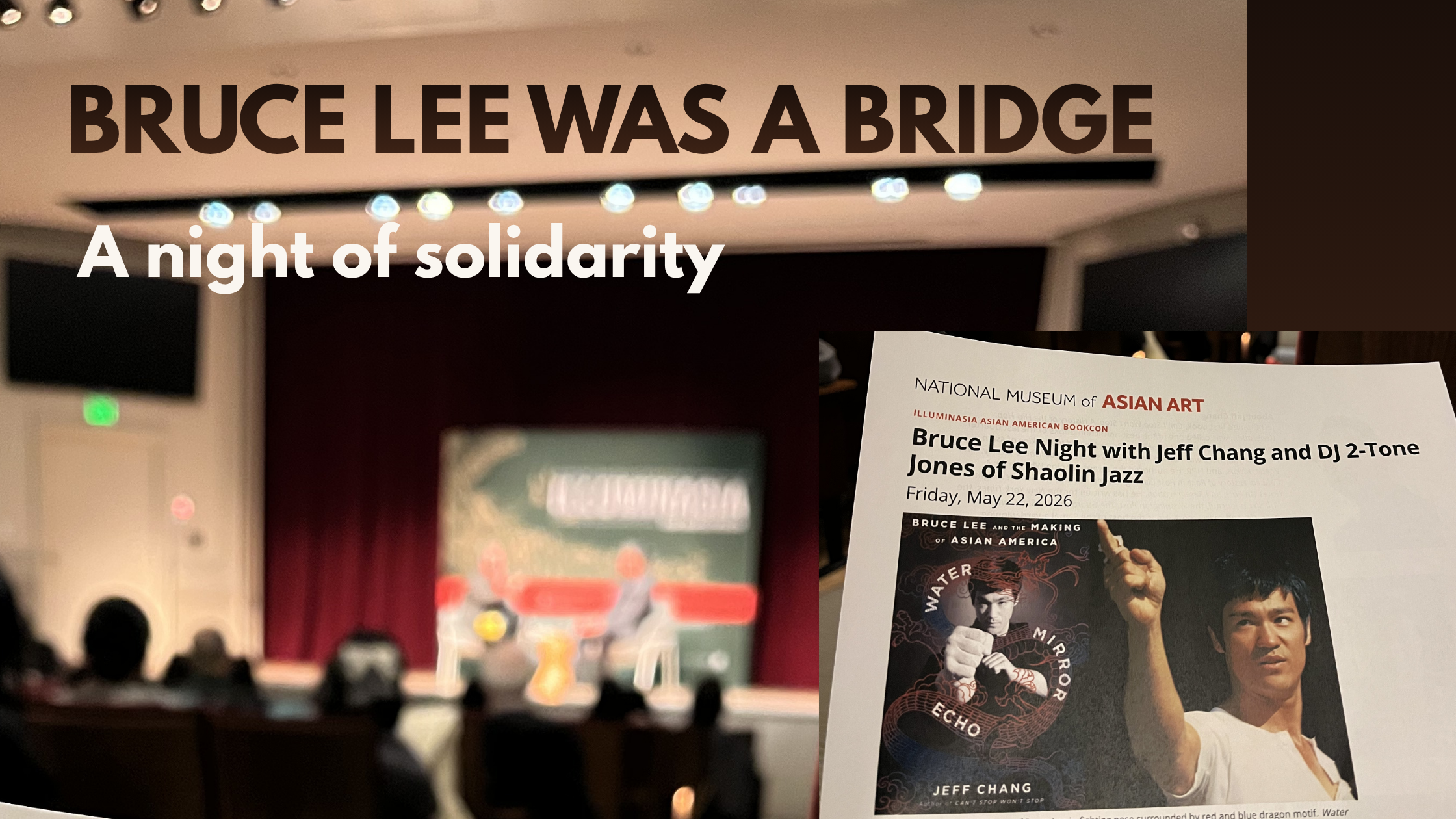
At the National Museum of Asian Art in Washington, DC, author Jeff Chang and DJ 2-Tone Jones of Shaolin Jazz explored how Bruce Lee became a shared symbol of solidarity between Asian American and Black communities in the late 1960s and early 1970s. Here is what the night meant to us at Unieros.
There are moments when history stops feeling like a textbook and starts feeling like something in the room with you. We had one of those recently at the National Museum of Asian Art.
The evening began with Theo Gonzalves, curator at the National Museum of American History, interviewing author and cultural historian Jeff Chang — whose book Water Mirror Echo: Bruce Lee and the Making of Asian America was named one of 2025's best. Following was an on screen Bruce Lee film with live DJ music by 2-Tone Jones, who spun a live soundtrack.
How Did Bruce Lee Shape Solidarity?
Many people grew up knowing Bruce Lee as an icon of strength. But Chang's work invites us to see something larger. Bruce Lee was a bridge — a figure who connected communities the world too often kept apart.
In the late 1960s and early '70s, Asian American activists watched Lee's films alongside Black, Chicano, and working-class audiences. When his characters refused to be humiliated, the whole room would erupt. People from different histories recognized something shared in that defiance.
When Solidarity Becomes Real
The moment that stayed with us came when Chang reflected on what solidarity truly means: being able to look across ethnic lines and identify with another person's struggle — to see your own fight reflected in someone else's, and to stand with them because of it.
We felt inspired by this line because it is, in essence, everything we have believed at Unieros that "One love" is not about erasing differences. It is about honoring our distinct roots while recognizing the common ground beneath them.
🎥 Watch the full experience here
As 2-Tone Jones played and Lee moved across the screen in the film The Big Boss, we saw his character avenge the wrongs against others. Different roots. One love.