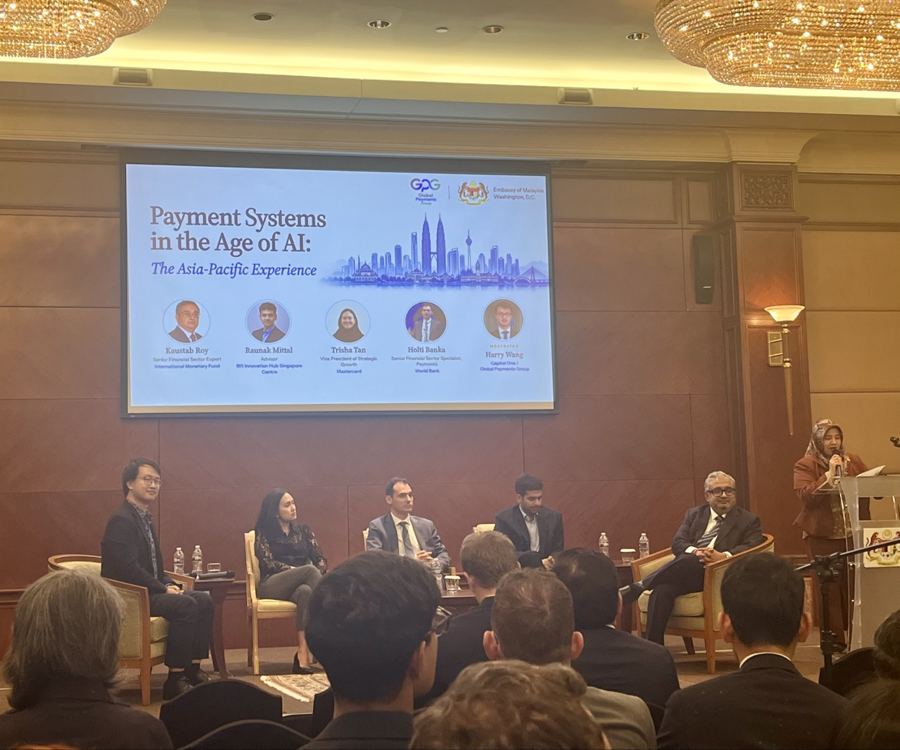
At a panel on payment systems at the Embassy of Malaysia in Washington, D.C., one of the speakers talked about sending money to his mother in India.
What stayed with me was his point: she doesn't care about the technology behind the transfer. She cares about what it can do for her, that it gets her the goods and services she needs. The technology is invisible to her. The purpose is everything. A payment is never just a payment.
That idea ran through the whole evening.
Another speaker described the moment that sparked a cross-border payment linkage between Singapore and Thailand. It began with a simple, human question: why can't I send money to Thailand the way I send it across town? Not a technology roadmap. A person wanting to reach another person.
A World Bank specialist talked about the small merchant, the street vendor who starts accepting QR code payments and, payment by payment, builds a credit history. That history becomes access to financing. Financing becomes expansion. A single scan becomes a job.
And then the harder story. In the Pacific Islands, roughly 60 percent of local banks have lost their correspondent banking relationships. Entire communities cut off from the global financial system, not because they did anything wrong, but because the pipes broke. New links between fast payment systems are giving them a way back.
When it doesn't work
One panelist put it simply: payment is one of those things you never think about when it works, and cannot ignore when it doesn't. That is why the panel kept returning to governance. Rules, recourse, accountability. If something goes wrong, who does the consumer call? Who walks them through the problem? Without answers to those questions, trust collapses and the best technology in the world falls over.
That matters even more as AI enters the picture. Fraud detection, compliance checks, agents transacting on our behalf: all of it needs guardrails built with humans in mind. Consumer protection, clear rules, regulators and industry working together. The technology can move the money. Only governance makes people believe in the system moving it.
The panel was called "Payment Systems in the Age of AI." All the technical pieces matter. But the thread connecting every topic was the same one the panelist named with his mother in India: the human factor is the true purpose. Behind every transaction is a person, a reason, and a relationship.
Technology earns its place when it serves that purpose. Faster, cheaper, more trusted payments mean more of the money reaches the people it was meant for, and more of the reason it was sent stays intact.
One Love, Many Cultures. Even in the age of AI, that is still the point.